
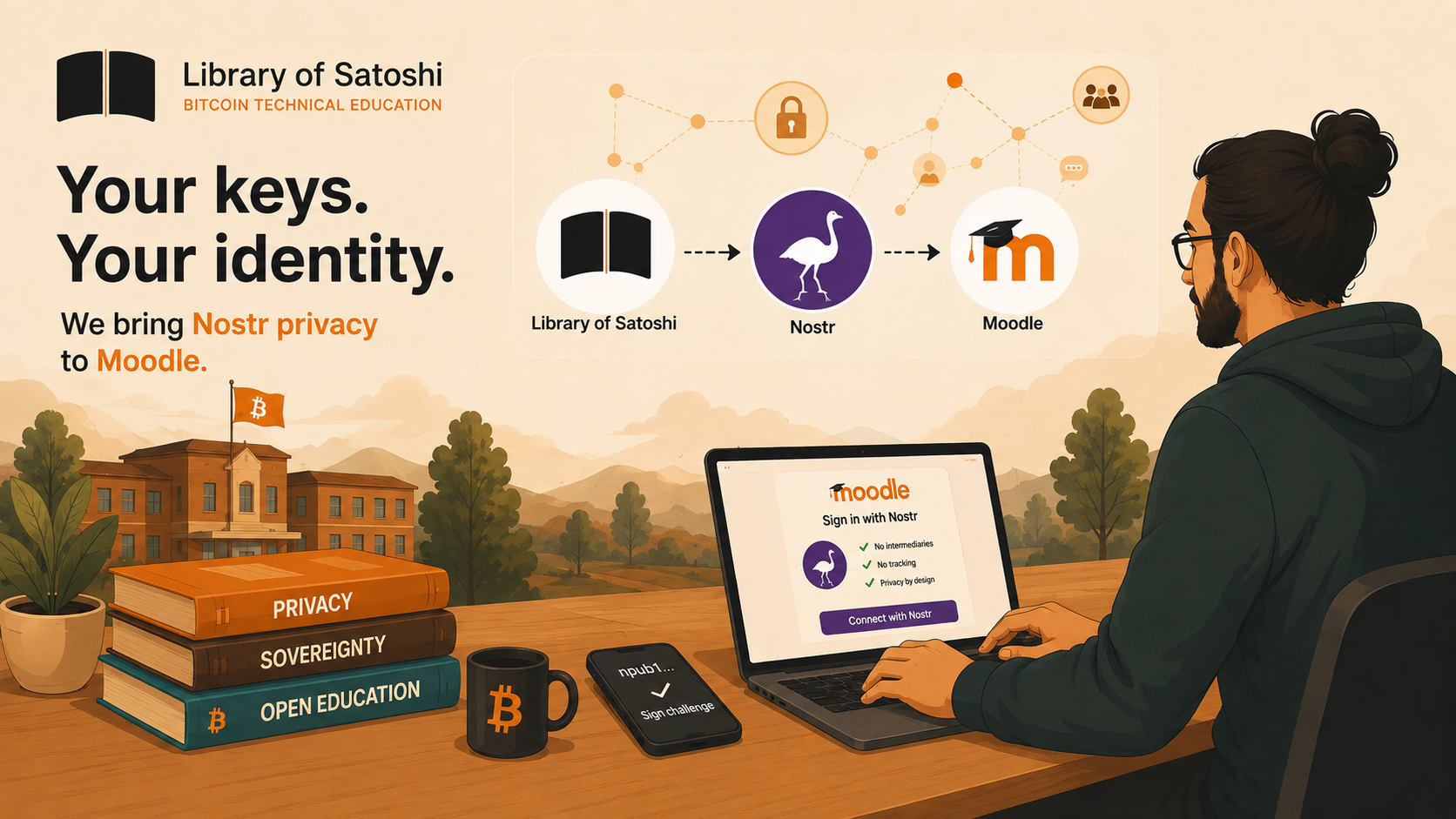
At Librería de Satoshi, we teach Bitcoin from a place of sovereignty: own keys, own identity. For years we've told our community that their key is their identity, that they don't need anyone's permission to own who they are. And yet, every time a student walked into our classroom, we asked them for exactly the opposite: an email and a password that depended on us.
Now, those who prefer to protect their privacy can do so. Our CTO, Iván Fuentes, took on the task of developing auth_nostr (Nostr Authentication), an open-source plugin that lets users log in to Moodle, the world's most popular open-source learning platform. You can now learn without a password and without an email — just your Nostr identity. It's already available for any educational institution.
Why does this matter, and what problem does it solve?
Any student with a Nostr identity (an npub) can enter the campus with one click, signing a cryptographic challenge with their favorite browser extension (Alby, nos2x, or any other NIP-07–compatible extension). No passwords to forget or recover, no dependency on email.
But why does it really matter? In many countries, studying Bitcoin, privacy, or cryptography can raise red flags with authoritarian governments. On top of that, data breaches and user data leaks are becoming increasingly common. Using Nostr protects your personal data.
How does it work technically?
Internally, the plugin generates a single-use, time-limited challenge and verifies the Schnorr signature (BIP340) on the server. The student's private key never leaves their browser — the server only ever knows the public key. This design earned our plugin the "Privacy Friendly" badge on the Moodle Marketplace. For our community, it's a natural fit: many of our students already live on Nostr, and their identity there becomes their identity in the classroom too.
Ideas that flourish in community
Iván had been carrying this idea around for a while, but it fully came together in Oslo, during Convergence — the gathering that And Other Stuff (AOS) hosts right before the Human Rights Foundation's Oslo Freedom Forum: days spent with brilliant, wildly diverse people from across the Nostr ecosystem, which let us deeply understand both the technical and the human sides of the protocol. We came back knowing exactly how to build it. Thanks to AOS for creating that space, and to the Human Rights Foundation (HRF) for the ecosystem of freedom and technology surrounding it.
The second piece that made it possible was the Moodle community itself: MoMoPDA (Modular Moodle Plugin Development Assistant), a collection of guides and prompts for developing Moodle plugins with AI assistants, created by Wilenius. It guided us in building the plugin following the platform's best practices from day one. Open source multiplying and strengthening open source.
auth_nostr was built entirely in-house at Librería de Satoshi and released as free software (GPL v3 or later) on our GitHub:
- Code: https://github.com/LibreriadeSatoshi/moodle-auth_nostr
- Official listing: https://marketplace.moodle.com/plugins/3880
Development took about eight weeks of iterative work (between May and July 2026): from a prototype with Schnorr verification in pure PHP and no external dependencies, through a battery of security tests, a review by the Moodle team, and finally publication. This is Librería de Satoshi's first public contribution to the Moodle ecosystem, the most widely used open-source learning platform in the world.
Now available on the Moodle Marketplace
The plugin was approved by Moodle's review team and is published on the Moodle Marketplace (the new official store that replaces the old plugin directory), ready for any educational institution in the world to install it for free on Moodle 5.1 and 5.2.
Any school, university, or educational project that wants to offer its community sovereign, passwordless login can install it today — and, like everything we build, improve it together with us: reviews, issues, and pull requests are welcome.
What's next
Login is just the first step. Our repository already lays out the plugin's future work:
- Remote signing with NIP-46 (bunker): log in without a browser extension, delegating signing to a remote signer.
- nsec login: an alternative for those who don't use an extension, signing in the browser without the private key ever being sent to the server.
- Account linking: associate existing Moodle accounts with a Nostr identity (the profile field already exists; the full logic is coming in an upcoming release).
And our most ambitious bet: messaging over Nostr. We want students who'd rather not use email to get campus announcements, course progress updates, reminders, and notifications sent straight to their Nostr identity. We're currently evaluating the best transport for this: from NIP-17 private direct messages, already compatible with most Nostr clients today, to the Marmot protocol (MLS over Nostr, the foundation behind the White Noise app), recently audited and offering the ecosystem's most advanced encryption guarantees. Sovereign identity not just to enter the classroom, but to communicate with it too.
If you're a Nostr developer interested in education, and want to help us build technology for sharing Freedom Tech knowledge — Bitcoin, privacy, cryptography — send us an email at hello@libreriadesatoshi.com. We're growing our team.
GitHub:
- Code: https://github.com/LibreriadeSatoshi/moodle-auth_nostr
- Official listing: https://marketplace.moodle.com/plugins/3880
Enroll in our courses and learn Bitcoin, Nostr, technical development, and many other tools, guided by the people already building this world.
Explore and enroll in our courses.


